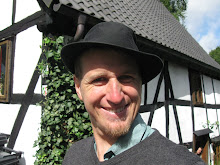
Traveller's tales...I'm a kiwi lad working my way around the world visiting family, making new friends and gazing at old stuff and wild stuff. I'm a writer, so I'm writing about it.

Saturday, June 30, 2007

Of hair and head-tilts


Yes, it’s been a while since my last entry. It’s not that I’ve been uninspired, in fact, I’ve been doing a lot of writing*. It’s just that I’ve been leading a rather pedestrian life, literally. My bike is in the garage here in Wirksworth and some days I don’t leave the house. Here in Wirksworth, an old town of 9000 in the limestone quarry part of the Midlands, the focus has really been family. With my Nana and Grandad (ninety-five and ninety-two) it’s flavoured by the numerous cups of tea, the stories of time spent in Malawi in 50’s, 60’s and 70’s, the bus trips to villages up the valley of the ‘mighty Derwent’. Helping them with some small challenges – opening fiddly juice containers and pesky email attachments - is a pleasure. Aunty Rosie and Uncle Graham are consistent with hugs and literature suggestions. Cousins Elliot and Alexander show me how to party – Wirksworth style. They have strange rules for pool here. And a wah-wah pedal! I also earn some pounds helping renovate houses for a local.

You may have heard of the flooding in nearby Yorkshire. Intense. Six people have died and there’s been around a billion pounds of damage. (Not nearly as bad as the floods in Pakistan, though) The rain definitely got to Derbyshire, but don’t fret, pet, we’re safe. Perched on a hill, it all drains away from Wirksworth.


What’s it like living here, in the midst of England’s countryside? You guessed it, it’s quaint. Quaint little “pooubs” quaint old shop-keepers who call everyone “duck”. Quaint houses from the local stone, strewn higgledy piggledy around the hills. And people probably think I’m quaint. Having conversations with people I pass myself off as normal; it’s the small interactions with strangers that I fumble my way through. I still haven’t completely weaned myself off the very kiwi eyebrow-lift, chin-tilt greeting and I pay the price in blank stares. And when people say “y’right?” over here, it’s a warm greeting, as Mel tried to teach me, not an anxious probe. And sometimes, like when I make jokes to strangers at the tennis court, I think maybe I’m just being too friendly, even for Wirksworth.

Even the monumental and historic buildings are quaint. I visit Cromford, a village famous for being the 1771 site of Lancashire entrepreneur Richard Arkwright’s deployment of mechanised cotton-spinning and the factory system. Some call it the birthplace of the Industrial Revolution. Most of the ”mills” (really factory buildings) still stand, large they may be, but (see photo) still pink and cute. Not like the working conditions. Surplus labour from the dying lead industry was exploited, and children crouched under the water-powered spinning machines to clean or “scavenge” any debris. If you weren’t bang on time for your twelve-hour shift, you couldn’t work any of the day. Those who know about my punctuality can envisage my potential cotton spinning pay-check. Other factories were even harsher, apparently


It really is a strange place to be spinning cotton. Several thousand miles from your nearest cotton field, it was only intense secrecy about industrial practices (and the protective measures of the British government) that meant the industrial revolution happened here, rather than closer to the cotton itself.

Arkwright had one of his mills destroyed early on by anti-mechanisation rioters (hooray!) and promptly developed a militia and a cannon to guard this one. Oh, yeah, I was talking about quaint. Get this. Arkwright picked the relatively remote Cromford for his project for several reasons – but how was this foreign guy familiar with the place? He was a wig maker, and travelled to large gatherings to gather the human hair for his wigs. The story is that nearby Wirksworth had a good deal of country fairs, and thus a good supply of hair. Arkwright came for the hair, but he stayed for the prime factory location!

*If anyone is keen on reading my new Roald Dahl-(think Tales of the Unexpected, not BFG)-esque short story, let me know, and I’ll swing you an email copy.

Wednesday, June 13, 2007

The best conversion of energy to distance/ is when your food is your fuel and your feet are your pistons.


I cycle north on my Uncle Keith's green touring bike through the midlands from Oxford. The countryside is a green sheet, punctuated. The commas of hedgerows, stops of tiny country villages. Church steeples form exclamation points and squirrel's tails make question marks.

It is delightful. I cycle through, not past the landscape, only slightly perturbed by the hazy smog that cuts out views. Cycling through a particularly lush avenue I raise my arm in glee, like a tour-de-france winner or a baptist testifying. The horse-rider approaching is confused. "The flies are bad around here, aren't they" she says.

I passed by more riders and walkers than I am cars. Two routes of the National Cycle Network (54 and 6) take me from Oxford to Derby, with only brief stints on major roads. They are detailed on a specially designed Sus(tainable)trans(port) map. Of course I lose the snaking cycle track (marked by little blue signs) about three times in every large town, but I am very grateful for this facility. Mad props.

My bike is laden with gear, which means I can't cycle no-hands (damm) let alone Vish's no-hands-no-bum trick. But it does mean I am self sufficient. I stayed my first night in a little thicket just off the road (shush). Tenting is great but it does make the brightness of the morning (4am at this time of year) very evident.

Solo cycle touring is also lonely, but I make friends rapidly through the couch-surfing website. Dave in Northampton is an accountant when he must, and a globe-trotter when he can. He is a very generous and fascinating host. Reevsie and Zena here in Leciester are lively conversationalists. They are also conservationists committed to living "low-carbon" lifestyles. There is a label on the plugs in the house detailing their electricity use. The cd player: "9 watts (playing)/7 watts (not playing) 3 watts (standby). Their dedication to their ecological footprint is both inspiring and challenging (a quota of two long haul flights for the rest of my life? gee.) I do feel at home when I discover they don't flush their pee, for water conservation reasons.

It's not all serious. Tonight Reevsie and I are making Willa Wonka sweets.

Wednesday, June 6, 2007

Large things in large town


My days in London settle into a vague pattern. Mornings are leisurely, evenings are social, afternoons I usually bus into the city, and experience the first traffic jams of my life. I go with vague errands (buying a phone/tent/harmonica, unrewarding illegitimate busking) but mostly my time in central London is spent walking around and staring at old things: surprisingly low stone builidings; commerative statues and arches of all descriptions; plaques, portraits and palaces. I’m equally attracted and repulsed by the monuments. A giant statue of Achilles made with cannon won in the battle of Waterloo? Bellicose jingoism. More difficult for me is the oft-present glorification of the era of British imperialism.

The injustices of British relations with other ethnicities are still sorely relevant for many. A man waves an Ulster flag among the massive Union Jacks along the Mall. Later I meet a pan-African crowd outside the National Gallery in Trafalgar Square. An impromptu protest has sprung up in the aftermath of activist Toyin Agbetu being released without charge after his pronouncements during the Abolition 200 (ending of slavery) service in Westminster Abbey back in March. Agbetu was arrested while declaiming what he has called the commemoration’s “myopic eurocentrism”. For the interested, here's a news piece on the March event.
The protest today involves a lot of drumming and pretty soon the National Gallery closes their main doors. Sympathetic and curiousI asked one of the protestors why they chose this spot. The protest started at the police station, and ended here partly by chance. My guy thought it was as appropriate a place as any. He gestures around Trafalgar Square. “Slaves built all of this” he says. I talk with him a bit, explain the phrase "kia kaha", (he hears kia kara), then move off to book my tickets for the Globe theatre.

Namvula encourages me to go to the British Museum – to “see all the stuff we stole” I do. The wizened and strangely shiny mummified Egyptian is very memorable. But it is looking at the exhibit of Viking doohickies that something hits me. The complexity of this island’s history. I present a list, familiar to most of you, but important nonetheless:

Invaders/colonisers of Great Britain
????? (Neolithic stuff)
Romans
Anglo-saxons
Vikings
Normans

Then a few centuries later, the mongrel inhabitants of this damp flat island spread an Empire to the antipodes. Bizarre. That’s what I think of when I see Nelson’s column.

Next time I write I will have tales of cycling through the Midlands.

Friday, June 1, 2007


I want to tell you about the sights I saw from the plane, 10km high flying Wellington to London via Hong Kong. I have been putting it off because, ideally, I would look up the names of places on GoogleEarth. I haven’t had a chance yet.


The first unusual sight is the desert. It is beautiful and naked. Thin ridges run like veins, ribs under the skin of red sand (or is it rock?) That’s about all. It is as if the creator, if you believe that sort of thing, had been in a remarkably austere and reckless mood. Rocks, sand, those weird ridges (let’s make them run due north, eh?) that’ll do. Oh, maybe some lichens, bacteria. Let’s make it red. This is real desert – utterly no sign of humans, for an hour. It seems so foreign. I am reminded of Ursula K Le Guins vision of the afterlife: that dry land…. But there does seems to be some water. We fly over patches populated by shallow salt-lakes, usually dry, but some seem to hold a pond in the center. Occasionally the ground below is marked with just-visible rashes of green.

The desert gradually melds into semi-desert. Now I start to see roads. Very straight roads. Roads like these that my father travelled. Days before I left, he told me, for the first time, the story of riding his motorbike, at sixteen, across the outback. Hitting sand dunes on the road and struggling to keep the bike upright. It’s a bit easier when you are seven miles up.

I wonder, marvel at the persistence and determination of our species. Who would live out here? Who could live out here? But people do. I notice some dwellings. We fly north-west, and as we near Alice Springs I see for the first time here valleys, gullies, creeks. The earth once again is shaped by water running off it, not just by the wind. It is something of a relief to see.

The landscape doesn’t change much until we leave Australia, somewhere near Darwin. I manage to see a few bejungled islands near PNG, and then the sun goes down. It’s a little symbolic. I know very little about Indonesia, the Phillipines, and we fly over them in darkness.

Going Hong Kong to London we pass over the mass of central Asia. Range after range of lumpy, forested mountains, then dry pointy mountains, then high, snow capped, gravely mountains. In between are expanses of land with little agriculture and settlement. I can see why. Sometimes giant sand dunes can be seen engulfing flat, arable land. Sometimes hills are terraced and farmed. Following the contours of the hills, these ancient techniques are visually stunning.

We fly over Mongolia, and then Siberia. Late spring up there and there is a lot of green. Serpentine rivers and lakes. Passing Novosibirsk, where Mel once lived, the cloud clears and I see a massive lake, but not the city.

The closer we get to Great Britain, the more homogenous the land below. Poland, Denmark, Gotland, the Netherlands. They all look the same from up here. Green pastures, intensely developed. I can imagine what the landscape looks like on the ground. My heart sinks a bit. I know that I am here, in Northern Europe, to connect with people, not monumental landscapes. I guess I’m just a bit greedy and want to do both at once. I will too, just wait.

Travellers congregate

(Written mainly on Monday 27 May.)

Temperature on arrival: twenty-six degrees celsius. Temperature today: ten.

What, dear readers, can I say about London? Many of you, I imagine will have been here at some point (bless our middle class cotton socks) for longer than me. I have been here for four days. At the moment I’m missing the wilderness, so let me tell you about birds and stuff.

Twice I’ve walked along the canal towards Paddington – the birdlife in the canal is impressive. Canada Geese calmly patrol the area. Most unusual are the moorhens. They have these amazing feet, with a series of round pads along the massive toes. This allows them, I suppose, to patter along lilypads and sneak through rushes. (I have to practice sneaking through rushes myself, to handle Regent Street. Ha!) By flailing their wings and pushing with these considerable paddles they can almost completely lift themselves out of the water while remaining stationary. Impressive. These dark, vocal birds are bullies: they chase birds twice their size from their very visible nests. They must do the same with predators.

Another highlight was seeing the pukekos. Yes, pukekos are found all over the world (so are sparrows. Hong Kong had a skinny, sweeter singing, territorial sparrow.) The pukekos here are much smaller, about the size of a bantam hen. They aren't of course called pukekos here. Wikipedia lists the names of this bird as: Purple Swamphen, Porphyrio porphyrio, African Purple Swamphen, Purple Moorhen, Purple Gallinule. My favourite is "Sultana Bird" - from the French - talève sultane. Porphyrio porphyrio here have more dark grey and less blue plumage, but they are unmistakably pukekos. They strut and flick their white arse like ours do.

Less similar to the antipodean version are the magpies. Here they are graceful, like large cuckoos, with a long tail. Namvula greets a magpie if it is solitary: ‘good morning magpie, how are your wife and kids?’. Not to do so brings on calamity. The crows are a bit of a favourite. Totally black, it’s as if you are always seeing them in silhouette.

Like most cities, there is not one, but thousands of Londons. Geographically, mine has centered around Ladbroke Grove where I am staying with my cousin Namvula. It is a suburb both refined and quirky. Trees, mainly plane trees, line almost every street (streets with names like Oxford Gardens) My first evening here I saw children practicing cartwheels on the pavement and a man biking with seven dogs on seven leads. Like the rest of London, he had no cycle helmet – hurrah! It makes cyclists seem much more human, much less freakish. I see posters advertising the health benefits of cycling on bus shelters. Good.

My London also has had an African side to it. Namvula’s mother is Zambian and many of her friends I have heritage in that continent. Ore, a Nigerian boy I met liked my beatboxing and we performed together at a talent quest in a South London school. I've heard a South African soul singer, Morrocan gnawa-jazz fusion, and 'Mama Africa' Miriam Makeba. This is a city of many possibilities, a city where it seems no-one is a true foreigner.

Tuesday, May 29, 2007

The quest for Kung Fu


The geography of Hong Kong is amazing. The city has leapt up among tall, steep hills covered in now-regenerating forest. The buildings echo the shape of the hills. Massive concrete high-rises – I estimate forty, fifty stories the norm. The up-side is a compact city - the human and wild seem very close here.

The city of Hong Kong covers a peninsula and a small archipelago. This means the water is a very important route of transport. The thin strait of Victoria harbour, (between Kowloon and Hong Kong Island), is turbulent with activity. Dozens of ferries, tub-like wooden fishing boats and even floating cranes chug through. Despite the human activity, the harbour does not seem devoid of other life. Egrets and birds of prey are common, and one fisherman is pulling up a net by the busiest commercial area. Bags not eating the fish though.

The scale of the port is simply staggering. If you take the bus from the airport you speed past it on the motorway. It still takes about five minutes to pass. Gargantuan cranes, shipping containers packed in lots two wide, four high, five long. I estimate about 50,000 containers on the docks, filled with who knows what – DVD players, shoes, rice, sofas. Still more containers out there on the harbour, sitting on the decks of floating cranes (some as large as small container ships) that lurk silently in the harbour. Sea trade is where it is at.

The smell of Hong-Kong: a delicious mix of Chinese restaurant, tropical jungle, and rubbish dump. The smell will linger on the clothes I have washed at a laundry there.

One of my ‘goals’ in HK is to see some martial arts. Kung fu is hard to find. Banners with Jackie Chan’s face, the statue of Bruce Lee on the tacky ‘avenue of the stars’. In the evening I ask at the ‘cultural centre’ about kung fu movies. ‘Oh, Chinese kung fu? People don’t like anymore.’ I mention the Bruce Lee statue just across the road. She sees my point, but makes it clear that I’m probably not going to walk into a picture theatre somewhere and see some kung fu. I’m puzzled. Come to think of it though, Jackie Chan’s image had been advertising a western style gym.

Tai Chi I do get to see. Hooray! During my brief stay I come across the classic image of a bunch of locals practicing after work in a park in Hong Kong Island. But even more inspiring is the couple practicing ‘push hands’ (a sort of slow motion combat) back in Kowloon in the evening. Powerful grace.

I depart from Hong Kong Airport, with its architecture reminiscent of a hangar and huge windows that look out to the mainland and mountainous Lantau Island. I feel sad leaving this place. The next step will be much further away in space, much closer in culture: Great Britain.

Wednesday, May 23, 2007

show you have a loving heart...


The double decker bus is nearing my stop on Hong Kong's Nathan Road in the Tsim Tsa Shui district of Mainland Hong Kong. I'm feeling a little trepidation. The last time I visited a city more foreign than Auckland was eleven years ago, and then I was under wings of the parental variety. (one pair of those set of wings managed to get themselves mugged, but that's another story).

The door hisses as it opens and immediately twenty or so faces, Chinese and Indian, are staring at me, they are shouting. My heart skips a beat. What could I have done wrong? I look again. They are holding up business card-sized bits of cardboard. Oh. They are business cards. They are asking me to patronise their guesthouses. Right-ho. Bewildered (the Kiwi version of hard sell is a slight raising of the eyebrows) I pick one (or did it pick me?) and stumble towards the auspiciously named "Fortunate Guesthouse" where Mr Lee and Ms Alice give me a cupboard complete with mildew, double bed and noisy airconditioning. I love it. And I move to the Chunkging Deluxe Hotel -bit cleaner -the next night.

The amusingly ironic part is that I had picked this particular complex of guesthouses because I thought I'd be arriving after midnight and it housed the one place I had found on the web with "24hr reception". I shouldn't have worried. I'm not sure if Tsim Tsa Shui ever sleeps, maybe it has a nap or something between 4:30 am and 5.

"What is Hong Kong like?" You ask someone who has been here almost exactly 24hrs. I want to come back and stay much longer. It is fascinating and it is pleasant. People are very polite and generous - offering me tailored suits and "copy watches" in the day time and hashish and "massages" in the night time. The hashish story is quite interesting. Permit me, gentle reader, to relate.

Jet-lagged and just plain tired, I can't help just popping out for a quick stroll and a midnight snack before bed. I haven't walked twenty paces before a scrawny guy dressed in black and a gangly guy with jeans and t-shirt are in my face, offering me drugs. I freak out a bit, and, despite what the internet says, quickly decide it's a bad idea to be out here this time of night. I spin on my heel and walk back into Chunking Mansions. (the aforementioned guesthouse complex - see the centre building in the picture) The gangly guy follows, which makes me more nervous. I shake him off and then the scrawny guy is back, this time actually showing me the dark-coloured pellet and something else in a bag. I tell ya, it's worse than Cuba St. He finally gets the message, and I try walking Nathan Rd again, the other direction. Gangly guy comes back and seems a little distressed. He keeps saying "Don't worry about that other guy" As soon as I mention him that I'm not going to tell anyone what happened his face relaxes and he moves off.
I eat some greasy noodles and egg and go to sleep.

But I wasn't joking about the politeness. Hawkers are hard-core on Nathan Rd because they are banned from most other tourist areas and possibly because begging is non-existent. People who serve you are helpful and warm, strangers strike up conversations on the train (he didn't invite me to the private club he bartends at though, dammit. Even the signs (so many signs) are polite.
"Climbing sculpture can be dangerous"

or even downright cutesy

"Show you have a loving heart: offer your seat to those in need" - seen on the train.

The signs are in English, as well as Chinese script; probably one of the most obvious signs of the country's history is the ubiquity of English, spoken and written. Only one or two people I have met can't understand any. Other than that, it feels like I imagine Asia should feel. Signs of the old Colonial history (Hong Kong technically left Britain merged with China in 1997) are sparse. In my experience they have been limited to: Lizzie's face on a few old coins; the British style cenotaph "to the glorious dead" in Hong Kong central; and, most hearteningly, a passion among some for cricket (but of course!). The train guy who talked to me played cricket and we had time to share an appreciation of Shane Warne's skills. Cricket. At least they didn''t throw out that baby with the bathwater.

More on (or even from) the delightful Hong Kong later.

Blessings on ya!